On Premise vs Off Premise: Which POS Fits Your Restaurant?
Compare on premise vs off premise POS for restaurants. Learn how each setup handles outages, reporting, costs, and growth so you can choose the right fit.
Restaurants today run on more than dine-in. With takeout, delivery, catering, and multiple locations in the mix, your POS setup has to match how you operate, not just how you take payments.
If you’re weighing on premise vs off premise options, you likely want fewer outages, faster menu updates, cleaner reporting, and smoother delivery integration. So what separates an on premise POS from an off premise POS, and which point of sale setup fits your budget, connectivity, and growth plans?
This guide walks through how each model works, what you get with each, and how to choose based on how your restaurant runs day to day.
What is On Premise POS?
An on-premise POS runs inside your restaurant. The software installs locally and works through your in-house terminals and, in many setups, an on-site server or controller. Your team takes orders, sends tickets to the kitchen, processes payments, and pulls reports through your local network.
Think of it as a system that “lives” on your property. It relies on your restaurant’s hardware and network first, rather than relying on a cloud connection for every step of the service.
This setup often fits restaurants that:
Push high dine-in volume and need consistent speed at the register and in the kitchen.
Deal with unreliable internet and want core operations to keep moving during outages.
Require deeper customization for menus, modifiers, kitchen routing, or unique service flows.
What an on premise POS setup includes
Most on-premise deployments include a few core building blocks:
Local server or controller This device coordinates the system. It connects your registers, kitchen screens, and printers so orders flow where they should.
Terminals, KDS, and printers on an on-site network Registers and handhelds take orders. KDS screens and printers receive tickets. Everything talks through your local network for quick routing.
Local data storage with optional cloud backup Sales data and tickets are stored locally for day-to-day operations. Many setups add cloud backup for extra protection and easier access to reports.
In-house or partner-managed updates and support Updates and maintenance follow a schedule your team controls or a partner handles. Support plans vary, so check hours, response times, and what’s included.
If you want a quick rule of thumb: on-premise works best when your operation depends on strong in-store performance and tight control over the hardware and network that powers service.
What is Off Premise POS?
An off-premise POS runs in the cloud. Your POS provider hosts the platform on their servers, and your team accesses it through an internet connection on registers, tablets, handhelds, or terminals.
Instead of keeping the “brain” of the system inside your restaurant, this model keeps it online and syncs your locations and channels through a single platform. You can update menus, review sales, and manage users from any device you log in on.
Off-premise POS often fits operations that:
manage more than one location
plan to open new units soon
rely heavily on online ordering, delivery, and catering
need consistent menus, pricing, and reporting across sites
What an off-premise setup typically includes
Most off-premise setups include a few core pieces:
Cloud dashboard for menus, pricing, and reporting Make a change once, then push it across your store or stores. Pull sales reports by daypart, channel, item, or location, and share them with your team fast.
Device and hardware options Run the POS on iPad, Android devices, or purpose-built terminals. Add handhelds for tableside service, plus kitchen screens and printers as needed.
Integrations for multi-channel sales Connect online ordering, delivery partners, loyalty, gift cards, inventory, and accounting exports. Keep orders flowing into one system instead of jumping between apps.
Remote updates and centralized management Roll out updates through the provider’s platform. Create roles, set permissions, and manage staff access across locations from a single admin view.
If you run multiple revenue channels, off-premise POS helps keep menus, orders, and reporting aligned, so your team spends less time correcting mismatches and more time serving guests.
On Premise vs Off Premise POS for Restaurants: Key Differences
Start with a simple split. An on-premise POS keeps more of your system on-site, so you control more of the hardware and day-to-day operation. An off-premise POS runs more in the cloud, so you get more flexibility for remote access and centralized management.
Here’s how that plays out in real operations:
Single location: On-premise can feel stable and self-contained, especially if your internet service drops more than you’d like. Off-premise can still work great, but you’ll lean more on connectivity.
Multi-location: Off-premise usually simplifies rollouts and standardization. You can push menus, prices, and user roles across locations from one place. On-premise can still scale, but it often needs more coordination across stores.
Daily workflows: The differences show up in how fast you can update menus, how you pull reports, and how quickly you resolve issues during service.
Cost structure and budgeting
Costs differ in timing and in who handles ongoing upkeep.
On-premise costs usually include:
Higher upfront spend: server/controller, terminals, networking gear, and installed software
Implementation fees: menu build, setup, on-site installation, training
Ongoing maintenance: hardware support, local repairs, and periodic upgrades
Off-premise costs usually include:
Subscription fees: monthly software costs, sometimes tiered by features or locations
Lower upfront spend: hardware still costs money, but you often skip the on-site server
Add-on fees:integrations, advanced reporting, online ordering modules, extra devices
Support and maintenance
On-premise setups often involve more coordination for updates, hardware issues, and network troubleshooting.
Off-premise setups often shift more platform maintenance to the provider, while your team still manages devices and on-site networking.
Lifecycle replacement planning
Plan for replacements on a cycle instead of waiting for a breakdown:
Server/controller hardware, if your system uses it
A simple approach: budget a refresh fund each year so replacements don’t hit all at once.
Reliability, offline operation, and internet dependency
This is the section that shows up on your busiest nights.
What happens during outages
With many on-premise setups, core functions can keep running locally: taking orders, firing tickets, and printing receipts. Some payment functions may still need a connection, depending on the processor and configuration.
With many off-premise setups, the system depends more on internet access. Some platforms offer offline modes, but the scope varies a lot.
Local network stability vs cloud dependency
On-premise lives and dies by your in-house network. A weak router, poor Wi-Fi placement, or an overloaded access point can cause issues even when the internet service appears fine.
Off-premise depends on your internet connection, plus the provider’s uptime. A strong connection and a backup line can reduce risk.
A busy Friday night scenario
The dining room fills, online orders spike, the bar prints nonstop, and a delivery driver waits at the counter. Then the internet drops.
With a strong on-premise setup, you can often keep service moving while you restore connectivity, then sync what needs syncing.
With a cloud-heavy setup, you may lose access to key screens or functions until the connection returns, unless the platform supports a robust offline mode.
If you rely heavily on delivery and online ordering, also think about what happens to incoming orders during an outage and how the system handles recovery.
Security and compliance responsibilities
Security work still lands on your plate in both models. The difference is who owns which parts.
Patches, backups, and permissions
On-premise: you or your provider manages local updates, backups, and server health. You control more settings on-site, so you also own more maintenance tasks.
Off-premise: the provider typically handles platform patches and hosted backups. You still manage access permissions, user roles, and device security in the restaurant.
Vendor vs restaurant responsibilities
No POS removes the need for strong operational controls. Focus on:
Secure network setup and segmented Wi-Fi for staff vs guests
Device controls for handhelds and tablets
Common expectations for SMBs and mid-market operators
Most teams want clear ownership and fast support. Look for:
A defined support process for peak hours
Clear backup and recovery standards
Written security practices and access logging
Guidance on network setup and device hardening
Off Premise vs On Premise: Which Fits Your Operation?
Pick the model that matches how your store runs on a busy day and how you plan to scale. Start with your non-negotiables: service continuity, control, and how often you need to change menus, pricing, and workflows across locations.
Choose on-premise when these are priorities.
Go on-premise if you want your core POS to keep working when connectivity drops and you prefer tight control on-site.
Offline resilience: Keep taking orders and routing tickets during internet disruptions, depending on your configuration.
Local control and customization: Control how the system runs in your store, including detailed workflows for modifiers, coursing, kitchen routing, and permission settings.
Stable single-location workflws: Keep daily operations consistent when one location drives most of your revenue, and you want everything tuned to that floor and kitchen.
Choose off-premise when these are priorities.
Go off-premise if you manage multiple stores or channels and need faster changes across the business.
Multi-location oversight: View sales, labor, and product performance across stores from one dashboard.
Faster rollout and remote menu updates: Push menu and pricing updates across locations quickly, with less on-site coordination.
Centralized reporting and integrations: Keep reporting consistent and connect ordering, delivery, loyalty, and accounting tools through a central platform.
If you want a quick way to decide, list your top three priorities from the bullets above. The model that hits all three usually fits your operation best.
How to Choose an On Premise POS System Without Overbuying
An on premise pos system can run well for years, but the wrong build can drain your budget. Focus on what your team needs on the busiest shifts, then size everything around that.
Right-size your setup for real service.
Start with your workflow, not a vendor bundle.
Count order points during peak hours. Include registers, handhelds, bar stations, and any curbside or catering checkout.
Map kitchen routing. Add KDS screens and printers by station (grill, fry, pantry, bar) so tickets land in the right place.
Choose a server that fits your volume. Don’t pay for enterprise-grade hardware if you run a single location with predictable traffic. For multiple units, standardize a proven spec across stores.
Buy add-ons only when they solve a daily need. Loyalty, gift cards, inventory, and delivery tools help when you actively run those programs. Skip features that won’t get used in the first 60–90 days.
Plan for support, not extra hardware. A solid support plan often prevents downtime better than a bigger server.
Vet the vendor’s support, upgrade path, and offline mode.
A good system on paper can still fail during service if support and updates don’t match your schedule.
Support model: Confirm hours, response times, and escalation. Ask how they handle Friday night issues.
Upgrade path: Ask how they handle feature updates over time, what costs extra, and how long they support your hardware model.
Offline mode: Get a clear list of what keeps working if the internet drops and what stops. Don’t settle for vague answers.
Plan the migration so the service stays steady.
Switching systems goes smoother when you treat it like an ops project.
Menu build: Share your menu structure early. Flag modifiers, combos, timed pricing, happy hour, and station routing.
Data: Decide what you’ll migrate (customers, house accounts, gift balances, item sales history) and what you’ll start fresh.
Staff training: Train by role. Managers need voids, comps, reporting, and labor tools. Cashiers need speed and accuracy. Kitchen staff need clear routing and bump flows.
Go-live plan: Schedule a soft launch during a slower period. Keep a rollback plan and a named contact for urgent support.
Questions to ask before purchasing an on premise pos system
Use these in demos and proposals so you can compare vendors side by side.
What is the true offline capability? Ask for a step-by-step list of what works offline: order entry, printing, cash payments, card payments, refunds, and end-of-day reports. Then ask them to show it.
How are updates delivered and supported? Confirm who applies updates, how long they take, and when they happen. Ask what happens if an update fails during business hours and how they roll it back.
Which integrations are available now, and which are available later? List the integrations you plan to run in the next 12 months: online ordering, delivery partners, loyalty, accounting exports, payroll, inventory, and catering. Ask which ones are native, which require a third party, and which require custom work.
What happens if hardware fails during service? Ask about replacement timelines, spare unit options, and swap procedures. Confirm what you can do immediately if a terminal, printer, or server goes down mid-shift.
When an On-Premise POS System Still Makes Sense in 2026
Cloud tools keep improving, but some operations still need a POS that runs on-site first. If your team relies on consistent ticket flow and tight kitchen execution, an on-premise setup can fit well.
Here are three situations where an on-premise pos system can still be the right call:
High-volume dine-in with detailed kitchen routing If you push a lot of tickets through multiple stations, routing has to stay sharp. On-site processing can keep orders moving from the terminal to the KDS and printers with fewer dependencies. That helps during rushes when you can’t afford delays at the expediting station, the bar, or the line.
Locations with spotty connectivity Internet hiccups happen. If your connection drops often, local processing helps you keep the core service running, take orders, and keep the kitchen moving. You can sync data once the connection stabilizes, instead of stopping service mid-shift.
Restaurants with specialized workflows Some menus and service styles demand more than a basic setup. Think custom modifier logic, coursing, timed firing, split kitchen routing, or unique bar and kitchen printing rules. An on-site system often handles these workflows with more control over configuration and device behavior.
If any of these sound like your day-to-day, keep the on-site option on your shortlist, then compare it head-to-head with a cloud setup based on how your team actually runs service.
Hybrid Approaches for Modern Restaurants
You don’t always have to pick one model and live with it forever. A hybrid setup lets you keep day-to-day service stable in the building while still getting the visibility and control you want across channels and locations.
Local reliability + cloud reporting
Keep core ordering and payment workflows running on-site, then sync the data to the cloud for reporting. You get:
steady service during internet hiccups
centralized sales and labor reports you can pull from anywhere
cleaner multi-location comparisons when you run more than one store
Multi-channel ordering with centralized controls
If dine-in, takeout, delivery, and catering all run through your POS, a hybrid approach can help you manage them from one place. Set menus, pricing, hours, and item availability centrally, then push updates across channels so teams don’t chase changes at the last minute. This also helps keep prep, routing, and pickup timing consistent.
A phased approach works well when you want progress without a hard cutover.
Start with on-site reliability for service and kitchen flow.
Add cloud features like reporting, remote menu updates, and user management.
Move more functions to the cloud over time as your connectivity, locations, and channel mix support it.
If you plan to expand or standardize across stores, hybrid gives you room to grow while keeping daily operations steady.
Pick the POS Model that Supports Your Day-to-Day
The best POS setup supports service when the dining room fills up, online orders spike, and the kitchen prints nonstop. Start with what you need most: stable checkout and ticket flow, faster menu updates, clear reporting, and a path to grow across channels or locations. From there, compare on-premise and off-premise options based on cost timing, internet reliability, support coverage, and how quickly you want to standardize across stores. A hybrid approach can also give you local performance on-site with cloud access for reporting and management.
Want to see how a POS can combine local stability with cloud access in one system?
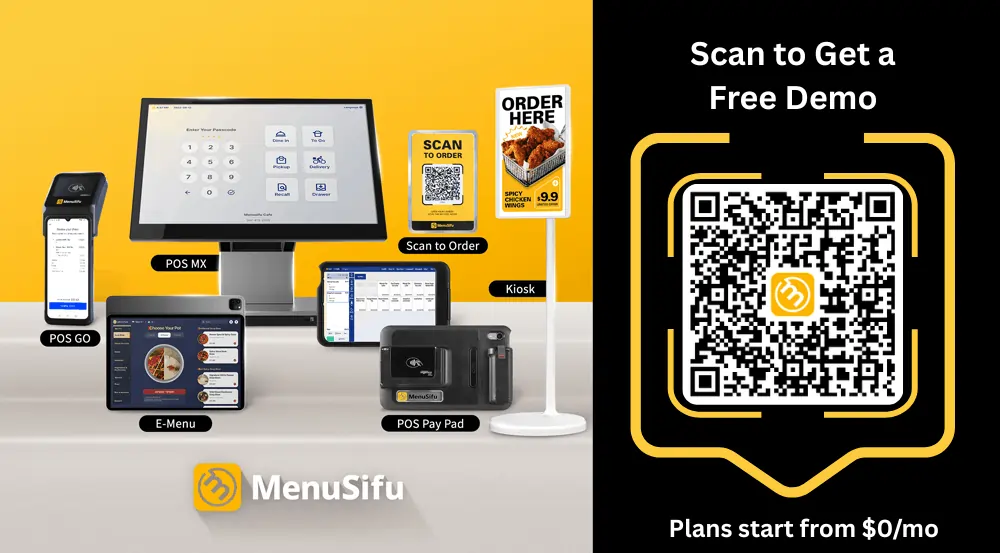
Book a Free Demo with MenuSifu today! MenuSifu POS supports restaurants with dependable on-site performance and the convenience of cloud reporting, so you can manage menus and orders reliably while checking results from anywhere.
Frequently Asked Questions About Off Premise vs On Premise POS for Restaurants
Here are quick answers to the most common points that come up when comparing these two POS models.
What is the Key Difference Between a Cloud-Based POS System and an On-Premises POS System?
A cloud-based POS runs on remote servers and stores data online, so you can access sales, orders, and reports from any internet-connected device. An on-premises POS runs on servers installed at your restaurant and stores data locally, so it relies on in-house hardware and maintenance for access and updates.
What's an Example of On-Premise?
An example of on-premise is a restaurant POS that runs on an on-site server or local controller connected to your registers, kitchen display system, and printers. It processes orders and stores data on your local network, and it can keep core functions running even if the internet drops.
Is On-Premise Becoming Obsolete?
No. Cloud adoption keeps growing, but on-premise still fits many restaurants. Operators pick on-premise for strong offline operation, local control, and stable in-store performance during internet issues. In many cases, teams run a hybrid setup: on-site processing for service plus cloud reporting and remote management.
What are the Disadvantages of On-Premise?
On-premise POS systems demand higher upfront spending for servers, terminals, and local installation, and they add ongoing costs for maintenance and IT support. Your team handles updates, backups, and security patching, and hardware failures can interrupt service until you repair or replace equipment. Remote access and multi-location management often need extra setup or add-ons, which can increase costs and slow expansion.
For more insights and updates, explore the rest of our blog for POS planning tips, restaurant tech guides, and operational best practices.