July 28, 2026

Best Clover POS Alternatives for Restaurants

Compare the best Clover POS alternatives for restaurants, including MenuSifu, Square, Toast, and Lightspeed. Review features, pricing, hardware, and support.

A POS system touches every order, payment, kitchen ticket, and sales report. If costs keep rising, staff struggle with menu changes, or key tools sit across separate platforms, it may be time to compare a Clover POS alternative.

This guide reviews MenuSifu, Square, Toast, and Lightspeed based on restaurant features, hardware, pricing, support, and expansion tools. The comparison will help you identify which platform best fits your daily operations, service model, and long-term plans.

Reasons to Consider a Clover POS Alternative

Clover can serve many restaurants well, but another platform may fit your operation more closely. You may need deeper menu controls for modifiers, combos, and service limits, along with workflows built for full-service, quick-service, takeout, AYCE, hot pot, or bubble tea concepts.

You may also want greater control over payment processing and total technology costs. Some providers combine ordering, kitchen tools, loyalty, marketing, financing, and automation in one connected system. Others offer hands-on setup, staff training, multilingual menus, bilingual technical support, and tools that support additional locations and ordering channels.

The best Clover POS alternative depends on how your restaurant operates, which tools need to connect, and the level of support your staff expects from a technology provider.

How We Evaluated Clover POS Alternatives

A restaurant POS affects service, payments, kitchen communication, and business oversight. To compare each Clover POS alternative fairly, we reviewed five areas that shape daily use and long-term value.

Restaurant Functionality

Your POS should support the way orders move through the restaurant. We reviewed menu management, modifiers, table service, order routing, kitchen displays, employee permissions, online ordering, delivery, and reporting. We also considered how easily staff can complete routine tasks during a busy shift.

Hardware and Reliability

Reliable equipment helps keep service moving throughout the day. We compared countertop terminals, handheld devices, kiosks, customer-facing displays, and kitchen screens. We also reviewed hardware durability and offline capabilities during an internet outage.

Pricing Structure

The advertised monthly fee covers only part of the total cost. We compared software subscriptions, hardware prices, payment-processing rates, optional products, contract terms, and implementation charges. This gives you a clearer view of what each platform may cost over time.

Setup and Ongoing Support

A smooth launch can reduce training time and operating disruptions. We looked at menu configuration, installation, employee training, technical support hours, language options, and available contact channels. Strong support can help your staff resolve issues quickly during service.

Expansion Capabilities

Your POS should remain useful as you add locations, devices, and ordering channels. We reviewed multi-location controls, loyalty programs, marketing tools, customer data, automation, integrations, financing, and consulting services.

1. MenuSifu: Best for an Integrated Restaurant Technology Ecosystem

MenuSifu combines restaurant POS software with payments, ordering, loyalty, marketing, financing, consulting, and automation. This connected ecosystem gives you one provider for daily operations and several related business services. MenuSifu also focuses on food-service concepts with detailed menus, multilingual needs, and specialized ordering rules.

Restaurant Functionality

MenuSifu connects point-of-sale, menu management, handheld ordering, tableside payments, kitchen displays, waitlists, reservations, kiosks, QR ordering, online ordering, and delivery integrations. You can also manage loyalty points, coupons, SMS campaigns, employee permissions, time records, tips, overtime, and mobile reports.

The system organizes dine-in, takeout, phone, online, and delivery orders in one synchronized workflow. Menu updates and sold-out items can sync across connected channels, which helps staff work from the same item data throughout the restaurant.

MenuSifu also supports detailed modifiers, combo rules, preparation requests, portion choices, printer routing, and multilingual menus in English, Spanish, Chinese, and French. These controls can suit Chinese, Japanese, Korean, Thai, Vietnamese, and Mexican restaurants, along with hot pot, BBQ, AYCE, café, bakery, fast food, and bubble tea concepts.

AYCE restaurants can configure meal duration, quantity limits, and ordering intervals. Bubble tea businesses can connect ordering with kiosks, label printing, pickup displays, marketing screens, and automated drink equipment.

Hardware and Reliability

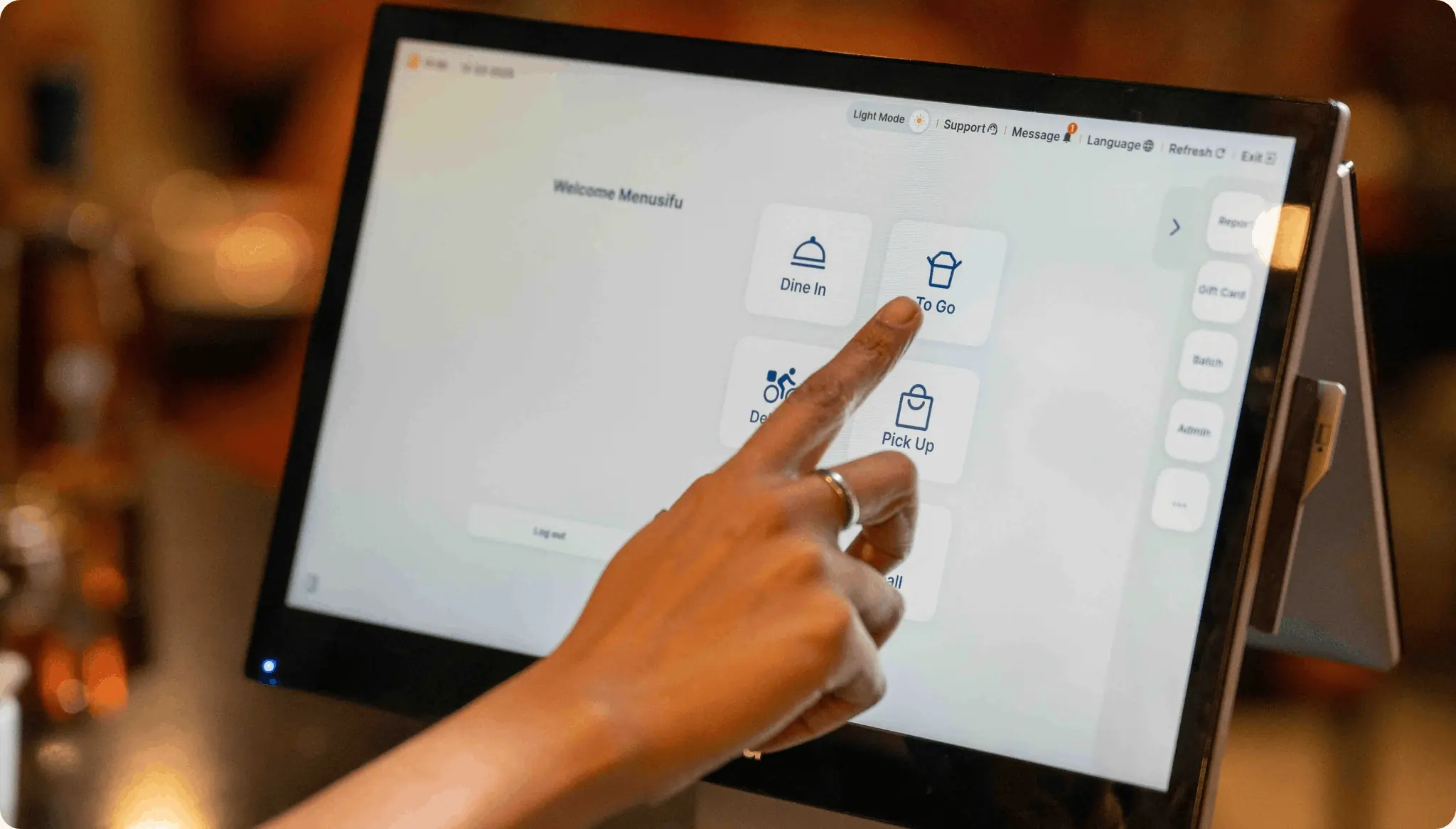
MenuSifu offers the POS MX with a 15.6-inch display and stainless-steel construction. It also offers a compact POS iPad with flexible placement. The wider hardware range includes handheld devices, customer-facing displays, kitchen screens, kiosks, payment terminals, printers, and order-status screens.

Local operation and cloud access support both service continuity and remote reporting. MenuSifu states that connected devices can continue processing orders and payments during an internet outage. Its handheld POS and kitchen display system also support offline operation through a local network.

Pricing Structure

MenuSifu offers a Pay-As-You-Grow plan starting at $0 per month, plus Basic, Pro, and Premium plans. Basic targets smaller restaurants, Pro adds delivery integration, tablet ordering, waitlist, and reservation tools, and Premium adds chain-focused features such as multi-store gift cards and split funding.

The company also offers purchase and subscription choices, custom payment-processing rates, and financing options. Request an itemized quote based on locations, terminals, handhelds, kitchen screens, selected modules, payment volume, installation, and support. This gives you a clearer view of the full cost.

Setup and Ongoing Support

MenuSifu handles menu programming, backend configuration, on-site installation, and hands-on training. The company states that most restaurant onboarding takes about three days. It also lists 24/7 bilingual technical support and direct hotline access.

Support can extend beyond the POS through connected services for websites, online ordering, promotions, loyalty programs, SEO, social media, financing, and consulting. MenuSifu reports serving more than 15,000 restaurants.

Growth Capabilities

MenuSifu can support additional locations through centralized menus, multi-store gift cards, shared reporting, location controls, delivery integration, and payment services. Its ecosystem also connects restaurant technology with marketing, financing, consulting, kitchen automation, digital screens, and automated boba equipment.

This structure may suit you if you prefer one business relationship across several restaurant functions. It can also fit restaurant groups that need detailed menu controls, bilingual assistance, high-volume ordering tools, or concept-specific automation.

Who MenuSifu Is Best For

MenuSifu may fit your restaurant if you:

  • Operate a full-service, quick-service, takeout, or delivery-focused restaurant.
  • Manage detailed menus, modifiers, combos, or ordering restrictions.
  • Run an Asian, AYCE, hot pot, BBQ, or bubble tea concept.
  • Need multilingual menus, bilingual support, and connected POS, payments, marketing, and automation tools.

2. Square for Restaurants: Best for an Accessible Starting Point

Square for Restaurants offers a recognizable platform, a free software tier, paid upgrades, integrated payments, and a broad hardware selection. Its setup can fit smaller operations that want to begin with core restaurant tools and add services later.

Restaurant Functionality

Square supports counter, tableside, and online ordering, along with menu modifiers, coursing, item splitting, bar tabs, pickup, delivery, team management, and live reporting. Restaurants can also add Square KDS, kiosk software, loyalty, marketing, payroll, and banking services.

The platform can serve quick-service and full-service restaurants, cafés, bakeries, bars, breweries, and multi-concept businesses. Cloud access lets you manage menus, sales, inventory, and other business data remotely.

Hardware and Reliability

Square offers countertop terminals, stands, card readers, handheld devices, kitchen displays, and kiosk options. Some restaurants can reuse compatible iPads, printers, cash drawers, and routers, while others may choose Square-branded hardware. Hardware costs are separate from the restaurant software subscription.

Square supports offline payments on eligible hardware. Time limits vary by device, and Square recommends reconnecting and uploading stored payments within 24 hours. The restaurant remains responsible for expired, declined, or disputed transactions accepted while offline.

Pricing Structure

Square currently lists Free at $0 per location per month, Plus at $49, and Premium at $149. Payment-processing rates vary by plan, and the monthly fee applies to each location on Plus and Premium.

Some tools add separate device fees. Square currently lists KDS at $30 per device on Plus and $20 per device on Premium. Its kiosk app costs $50 per device on Plus and $30 per device on Premium.

Before choosing a plan, calculate processing, hardware, location fees, KDS screens, kiosks, loyalty, marketing, payroll, and third-party services.

Setup and Ongoing Support

Square lets businesses create menus, import item data, and configure the POS through an online account. It also offers one-on-one implementation services and 24/7 customer support. Hardware setup and menu migration needs can affect the launch process.

Confirm which implementation services come with the selected plan, how Square handles gift-card migration, and which support channels apply to your account.

Growth Capabilities

Square connects POS with online ordering, team management, payroll, loyalty, marketing, banking, and multi-location menu tools. These products can help a smaller restaurant add functions under one brand as its needs expand.

Square may fit new restaurants, cafés, bakeries, food trucks, counter-service concepts, and smaller businesses with simpler menus. It can also suit businesses that rely on other Square products.

Who Square Is Best For

Square may fit your restaurant if you:

  • Operate a café, bakery, food truck, bar, or counter-service concept.
  • Manage a smaller restaurant with a relatively simple menu.
  • Want to start with a free monthly software tier.
  • Already use other Square business products.

3. Toast: Best for a Restaurant-Centered Platform

Toast builds its software and hardware around food-service operations. The platform connects POS, payments, online ordering, delivery, kitchen tools, employee management, inventory, marketing, and multi-location controls.

Restaurant Functionality

Toast offers restaurant POS software, Mobile Order and Pay, online ordering, third-party delivery connections, loyalty, gift cards, email marketing, guest profiles, inventory tools, scheduling, tip management, payroll, catering, and multi-location management.

The product catalog serves concepts such as bars, cafés, bakeries, casual dining, food trucks, pizza shops, fine dining, sushi restaurants, hotels, catering businesses, and drive-thru operations. You can add products as operational needs expand, though each addition can affect the monthly cost.

Hardware and Reliability

Toast offers Flex countertop terminals, Toast Go handheld devices, self-ordering kiosks, and kitchen display systems. Toast designs its hardware for hospitality use and requires approved compatible devices for access to its services.

Toast provides offline capabilities for selected restaurant tasks, with network requirements that depend on the installed setup. Review the connection plan, offline payment process, and any backup hardware before launch.

Pricing Structure

Toast advertises a Starter Kit beginning at $0 per month for qualifying new, single-location customers. It also offers paid POS packages and custom configurations. Hardware, installation, payment processing, additional devices, and optional products can increase the total cost.

Toast’s Pay-as-You-Go option can reduce upfront hardware and installation expenses through an all-in-one platform rate. Before choosing a package, request an itemized proposal covering software, hardware, implementation, processing, online ordering, payroll, inventory, marketing, contract terms, and other selected products.

Setup and Ongoing Support

Toast includes Toast Care with every software subscription and provides support 24 hours a day through phone and web messaging. Implementation costs vary according to the hardware package and installation requirements.

Review menu migration, installation responsibilities, staff training, hardware replacement, data transfer, and cancellation conditions before signing. A written scope can clarify which services Toast handles and which tasks remain with your staff.

Growth Capabilities

Toast offers multi-location management, benchmarking, integrations, guest data, loyalty, marketing, payroll, capital products, and supplier tools. This broad catalog may suit restaurants that want a food-service platform with many optional products under one provider.

Toast may fit full-service, quick-service, and fast-casual restaurants that prefer Toast hardware and payment services. It can also suit businesses that expect to add online ordering, inventory, labor, guest engagement, or multi-location tools over time.

Who Toast Is Best For

Toast may fit your restaurant if you:

  • Operate a full-service, quick-service, or fast-casual concept.
  • Prefer restaurant-focused software and hardware.
  • Need handheld ordering, kiosks, or kitchen displays.
  • Plan to add payroll, inventory, loyalty, or marketing tools.

4. Lightspeed Restaurant: Best for Reporting and Multi-Location Management

Lightspeed Restaurant combines customizable menus, floor plans, payment tools, online ordering, operational reports, and multi-location controls. Its feature set places strong emphasis on table-service management, performance data, and location-level oversight.

Restaurant Functionality

Lightspeed supports menu management, modifiers, table layouts, coursing, pre-authorized bar tabs, takeout, delivery, online ordering, contactless ordering, reservations, order-at-table tools, inventory, and integrations. Its mobile app also provides performance data across restaurant sites.

The platform can suit restaurants that rely on detailed floor plans, table controls, stock tracking, and location-specific oversight. Lightspeed also provides customer-facing displays, kitchen screens, and order pickup screens.

Hardware and Reliability

Lightspeed offers restaurant hardware that includes customer-facing displays, kitchen display systems, and pickup screens. The KDS gives kitchen staff a live ticket overview and tracks preparation time.

Lightspeed also promotes offline operation, though available functions can depend on the product version and payment setup. Confirm which order, payment, printing, and reporting tasks remain available during an outage.

Pricing Structure

Lightspeed currently lists Starter at $69 per month, Essential at $189, and Premium at $399. It also offers Enterprise pricing through a custom quote. Feature access varies by tier, and some products carry added fees.

The company currently lists KDS at $30 per screen per month. Reservations, advanced inventory, tasks, integrations, and professional services may require a higher tier or added charge.

Calculate the cost across every location, terminal, kitchen screen, integration, and optional service before comparing Lightspeed with another provider.

Setup and Ongoing Support

Lightspeed provides onboarding resources, support services, and higher-touch professional services on selected plans. Enterprise packages include launch and consultation services, a dedicated support team, and a customer success manager.

Confirm the onboarding scope, menu setup, training format, support hours, hardware installation, and help available for multi-location deployment.

Growth Capabilities

Lightspeed supports multi-location management, location-level menus and prices, consolidated reporting, advanced inventory, mobile performance tracking, raw API access, and third-party integrations. These tools can help restaurant groups manage several sites while preserving local menu or pricing differences.

Lightspeed may fit full-service restaurants, bars, hotels, and multi-location groups that place a high priority on reports, floor plans, inventory, and site-level controls.

Who Lightspeed Is Best For

Lightspeed may fit your restaurant if you:

  • Operate a full-service restaurant with detailed floor plans.
  • Manage multiple locations or plan to expand.
  • Rely heavily on reporting and performance data.
  • Need location-specific menus, pricing, and controls.

Clover POS Alternatives Comparison Table

Each platform supports a different restaurant setup. Use this comparison to identify which option fits your service model, operational needs, and budget before reviewing detailed proposals.

Alternative Best suited for Primary differentiator Pricing approach Key item to verify
MenuSifu Restaurants with detailed menus, specialized workflows, or multiple locations Connected ecosystem covering POS, payments, ordering, loyalty, marketing, financing, consulting, and automation $0 entry option, tiered plans, and purchase or subscription choices Included modules, device costs, payment rates, and custom quote details
Square New restaurants, cafés, food trucks, bakeries, and smaller counter-service businesses Accessible setup, recognizable hardware, and a free software tier Free and paid monthly plans with transaction fees and optional device charges Paid feature limits, processing rates, support access, and per-device fees
Toast Full-service and quick-service restaurants seeking a food-service platform Restaurant-grade hardware and a broad catalog of operational, employee, and marketing products Entry plan with separate hardware, processing, implementation, and optional product costs Contract length, processing terms, add-on fees, and total ownership cost
Lightspeed Full-service restaurants and multi-location groups focused on reporting and location controls Detailed reporting, floor-plan tools, menu controls, and multi-location management Tiered monthly subscriptions with optional products and services Plan-based feature limits, location fees, integrations, and hardware requirements

Pricing and product information reviewed on July 29, 2026. Providers may change plans, fees, eligibility requirements, features, and availability. Contact each provider for a current itemized quote. 

MenuSifu stands out for connecting POS with payments, ordering, loyalty, marketing, financing, consulting, and restaurant automation. Square offers an accessible entry point for smaller operations. Toast provides restaurant-focused hardware with an expandable catalog of software products. Lightspeed emphasizes detailed reporting and location-level controls.

Compare each proposal using the same number of locations, terminals, handheld devices, and required features.

How to Select the Right Clover POS Alternative

A useful POS comparison starts with daily operations. Focus on how each platform handles real orders, supports staff, and fits your budget before reviewing extra features.

Document Your Restaurant’s Workflows

Map each step from order entry to payment and reporting. Your list may include:

  • Table and counter service
  • Takeout and delivery
  • Menu modifiers and combos
  • Kitchen routing
  • Split checks and tips
  • Loyalty programs
  • Employee roles and time tracking
  • Multi-location management

Rank each function by priority. This helps you identify which features are required and which ones can wait.

Calculate the Complete Cost

Request a written, itemized proposal from each provider. Include:

  • Software subscriptions
  • Countertop terminals and handheld devices
  • Kitchen screens and printers
  • Installation and staff training
  • Payment-processing rates
  • Online ordering
  • Loyalty and marketing tools
  • Third-party integrations
  • Technical support
  • Contract cancellation fees

Compare costs across several years rather than focusing on the advertised monthly rate. Include added devices, locations, and optional services in the estimate.

Test a Real Menu During the Demo

Use actual menu items during each product demonstration. Give the vendor examples such as:

  • Dishes with several modifiers
  • Combos and meal packages
  • Split checks
  • Course timing
  • Sold-out items
  • Happy-hour pricing
  • AYCE time and quantity limits
  • Menus in multiple languages
  • Online and in-store orders placed at the same time

Watch how quickly the system handles each task. Include a manager, cashier, or server in the demonstration so the people who use the system can evaluate the workflow.

Review Support and Implementation

Confirm how the provider handles setup and service issues. Review:

  • Support hours
  • Phone, chat, and email access
  • Language options
  • Hardware installation
  • Menu configuration
  • Staff training
  • Data migration
  • Equipment replacement
  • Service procedures during internet outages

Identify who handles issues involving both the POS and payment processing. Clear ownership can shorten resolution time during operating hours.

Plan for Expansion

Choose a platform that can support additional locations, devices, and ordering channels. Review its ability to manage:

  • Shared and location-specific menus
  • Pricing by location
  • Consolidated reports
  • Employee permissions
  • Multi-store loyalty and gift cards
  • New kiosks or handheld devices
  • Online ordering and delivery
  • Marketing across several locations
  • Restaurant automation

The right Clover POS alternative should fit current operations while giving you room to add services and locations without replacing the full system.

Choose a POS That Fits Your Restaurant

MenuSifu, Square, Toast, and Lightspeed each support different operational needs. The right Clover POS alternative should align with your menu, service model, budget, support expectations, and plans for expansion. Before deciding, compare total costs, test real menu workflows, and confirm which services and tools each proposal includes.

If you are looking to connect POS, payments, ordering, loyalty, marketing, and automation through one provider, MenuSifu may be worth considering. Book a Free Demo with MenuSifu today to see how the platform could support your daily operations and business goals.

Frequently Asked Questions About Clover POS Alternatives

Still comparing Clover POS alternatives? These quick answers cover leading competitors, pricing, monthly fees, and key points to review before choosing a restaurant POS system. 

What's Better than Clover?

No single POS is better than Clover for every restaurant. MenuSifu may be a stronger choice for detailed menus, bilingual support, integrated payments, marketing, and restaurant automation. Square may suit smaller operations seeking a low-cost entry point, while Toast and Lightspeed may fit restaurants that prioritize broad food-service tools or multi-location reporting. 

Who Are Clover's Competitors?

Clover’s main restaurant POS competitors include MenuSifu, Square for Restaurants, Toast, and Lightspeed Restaurant. MenuSifu offers an integrated restaurant technology ecosystem, Square provides an accessible entry point, Toast focuses on food-service operations, and Lightspeed emphasizes reporting and multi-location management. 

Is the Clover POS System Worth It?

Clover can be worth it for restaurants that want integrated payments, flexible hardware, and access to a broad app marketplace. Before choosing it, compare processing fees, monthly costs, contract terms, support, and restaurant-specific features. Another POS may fit better if you need advanced menu controls, multilingual tools, deeper kitchen workflows, or more hands-on service. 

Who Is Cheaper, Clover or Square?

Square may have a lower entry cost because its Free plan has no monthly software subscription fee. Clover restaurant plans generally include a monthly software charge, although pricing varies by package, hardware, and provider agreement.

The lower-cost option depends on more than the monthly fee. Compare payment-processing rates, hardware, additional devices, paid features, support, and contract terms to determine which system offers the better total cost for your restaurant.

Which POS has No Monthly Fees?

MenuSifu, Square for Restaurants, and Toast each advertise an entry-level option starting at $0 per month, but eligibility and included costs differ.

MenuSifu’s plan applies to eligible new restaurants using integrated payment processing. Square Free has no monthly software subscription, though processing fees apply. Toast’s Starter Kit begins at $0 for qualifying new, single-location customers and may include transaction-based charges, contract terms, and added device fees.

Visit the MenuSifu blog for more restaurant technology guides, operational insights, and product updates.

想把餐厅越开越好?
免费订阅,持续获取行业报告、经营洞察与实用工具。