September 15, 2026
Discover how AI is transforming restaurant operations, from voice ordering to marketing and analytics, and why connected technology is key to delivering real business results.
For years, "AI" in restaurants mostly meant a demo. A brand would roll out a chatbot or a flashy kiosk, use it to signal innovation, and move on, with little real change to how the restaurant actually ran day to day.
That's shifting. In 2026, AI is starting to show up inside everyday restaurant work, quietly taking on tasks that used to eat up staff time.
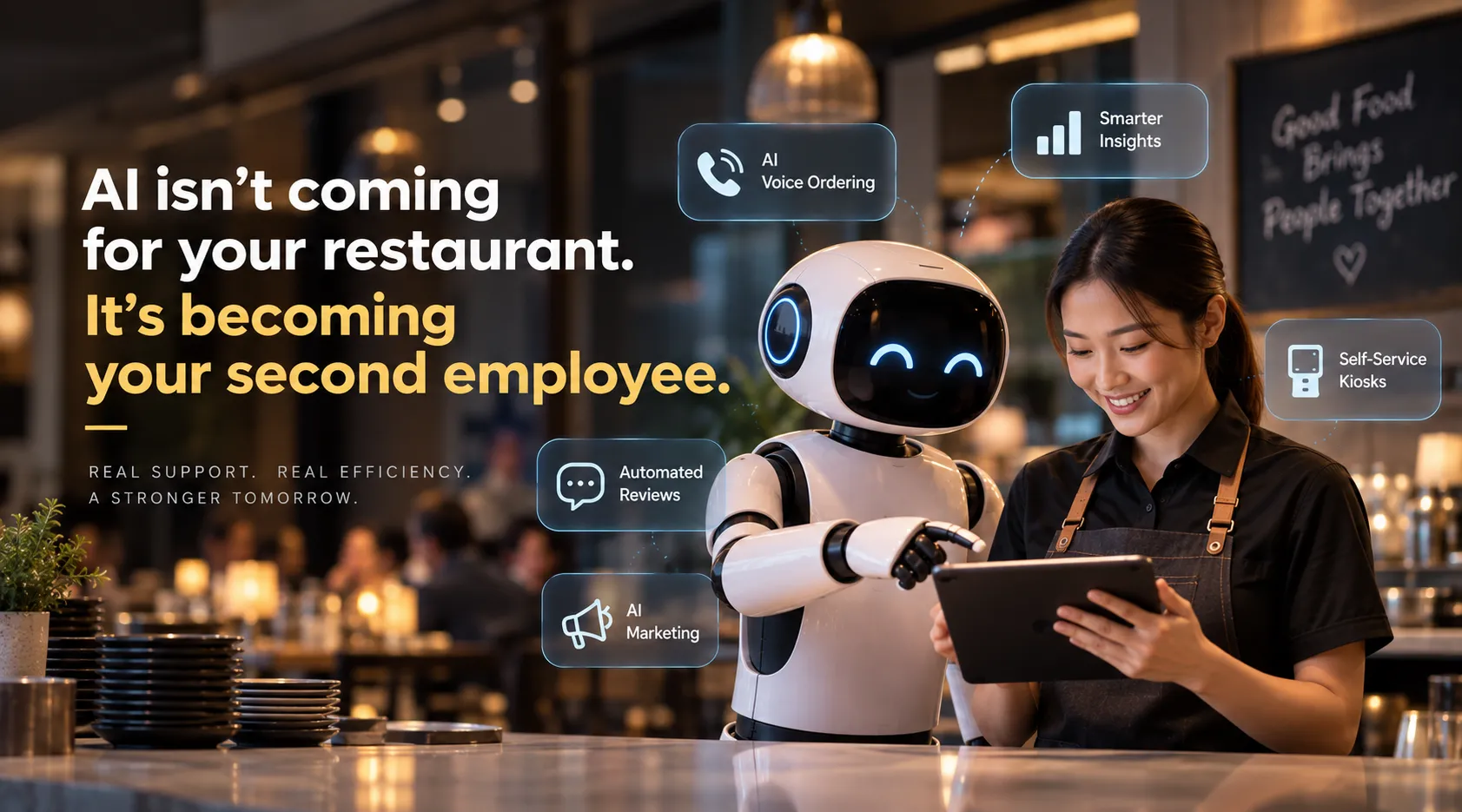
The most mature applications aren't dramatic. They're things like AI voice ordering, AI-assisted drive-thru, self-service kiosks, automated review responses, and analytics assistants that flag problems before a manager spots them.
None of these are headline-grabbing on their own. But they solve the same underlying problem from different angles: cutting repetitive work so people can spend their time elsewhere.
For most operators, the question isn't how sophisticated the technology is. It's whether it does something concrete:
That's the shift worth paying attention to: AI is moving from demonstrating what it can do to actually delivering outcomes operators can measure.
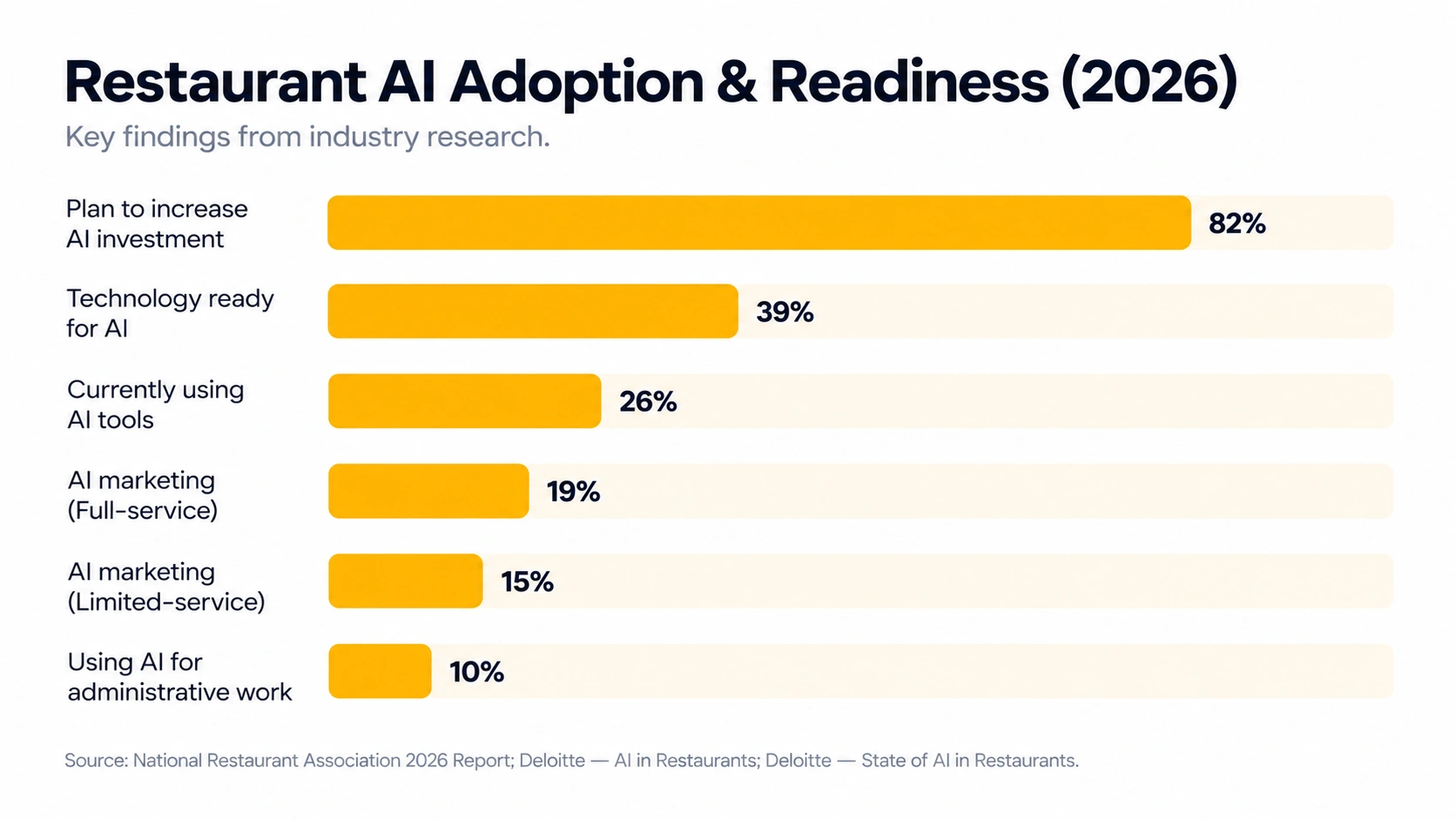
About 26% of restaurant operators report using AI-related tools today. Marketing is one of the fastest-growing areas. 19% of full-service restaurants and 15% of limited-service restaurants have adopted AI marketing tools, and 10% of operators are using AI for administrative work.
Looking ahead, 82% of restaurant executives plan to increase AI investment. Sixty percent see customer experience as the area where AI could matter most, and nearly a third believe it will meaningfully affect loyalty.
That's a lot of appetite for AI. It's also, for a lot of operators, still mostly ahead of them rather than already paying off.
Here's the number that matters more than any of the adoption stats: only 39% of operators believe their existing technology infrastructure is actually ready for AI.
That gap is the real story. AI voice ordering only works if it can create a real order in the POS. Personalized marketing only works if the AI has actual purchase history and loyalty data to draw from. An analytics assistant is only as useful as the completeness of the data it's watching — across every location, every channel, every daypart.
In other words, AI doesn't fix fragmented systems. It exposes them. A restaurant running five disconnected platforms won't get much value bolting an AI tool onto any one of them — the AI simply won't have enough to work with.
The restaurants getting real value out of AI right now aren't necessarily the ones with the most advanced models. They're the ones where POS, ordering, loyalty, and operations data were already talking to each other, so there was something worth connecting AI to.
Going into next year, the competitive question probably isn't "who has the most AI features." It's who can actually plug AI into daily operations and turn it into results that show up on a P&L — not just a demo.
Source data: National Restaurant Association 2026 Report; Deloitte — AI in Restaurants; Deloitte — State of AI in Restaurants.